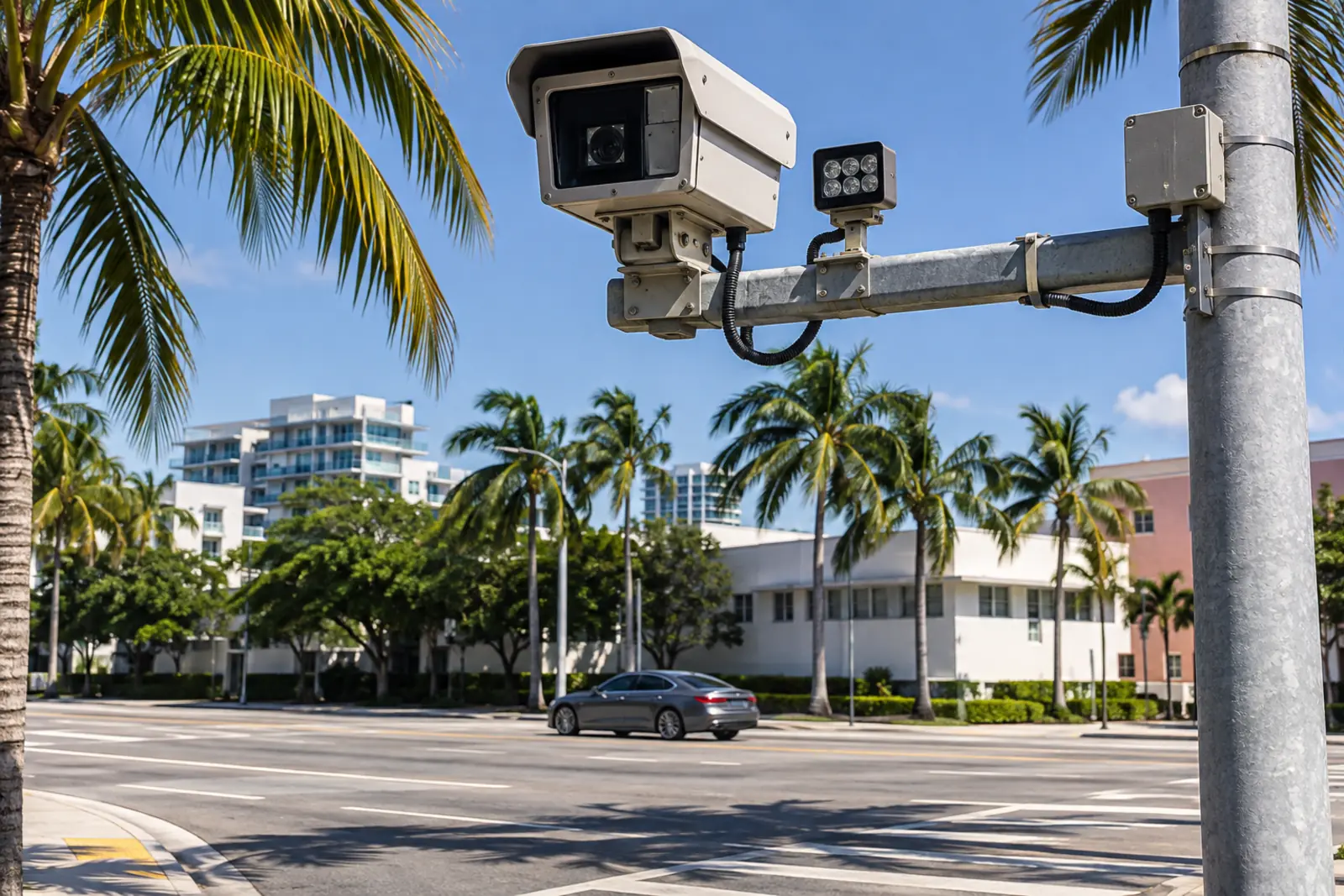
If a red-light camera catches a Miami rental car, the notice goes to the registered owner, which is the rental company. The company then either pays and bills the card you gave it, plus a handling fee, or sends your name and address to the agency so the notice is reissued to you. Either way the cost usually lands on the renter, and the deadline on the notice is real, so keep your paperwork, act the day anything arrives and read the fee terms before you sign.
Who actually receives the notice
Camera enforcement in Florida is aimed at the vehicle, not at a driver stopped by an officer. Under the state's red-light camera law, a notice of violation must be mailed to the registered owner within 30 days of the violation, as described in section 316.0083 of the Florida Statutes. When the car is a rental, that owner is the fleet company. The statute also lets an owner avoid liability by sending the agency an affidavit naming the person who had the car, including that person's name, address, date of birth and, if known, driver license number. In practice this is why rental agreements let the company hand over your information. If the car had been stolen, the affidavit must come with a police report instead.
Officer-issued tickets are different. If a police officer stops you for speeding or a lane violation, the citation is written to you personally and you deal with it as the driver, exactly as a local would. The company only learns about it if the court or your own report tells it.
The main types of notice and what each one means
| Type | How it is issued | What to expect |
|---|---|---|
| Red-light camera | Mailed notice of violation to the registered owner | Civil penalty of $158 under the state program; the owner (or you, once named) has 60 days to pay, name the driver or request a hearing |
| School-zone speed camera | Mailed civil citation to the registered owner | Miami-Dade's program lists $100 for driving 10 mph or more over the limit, enforced on school days around school hours |
| Parking ticket | Placed on the windshield or issued electronically by the city | Owner is responsible unless it identifies the renter; amounts and deadlines are set by the city or county |
| Toll violation | Plate photo billed to the owner | Covered separately in the guide to tolls and SunPass in a rental |
| Officer-issued citation | Handed to the driver | Your responsibility directly; may involve a court date or points |
Fine amounts and rules change, and cities set some of them locally, so treat the figures above as the published baseline and confirm them on the notice you actually receive.
What happens if you get a red-light camera ticket in a rental car
The $158 civil penalty is the figure set in section 318.18 of the Florida Statutes and printed on the notice of violation. The notice must offer three options within 60 days: pay the penalty, submit an affidavit naming the driver, or request a hearing. It must also say where you can view the photos or video of the violation, and no payment can be demanded before a requested hearing. A hearing is held before a local hearing officer, and if the violation is upheld the officer can add county or municipal costs of up to $250.
Paying the civil penalty is generally treated as resolving the matter without points on a license; the statutes quoted here do not spell out points, so confirm on the notice. If nothing is done in the window (no payment, no affidavit, no hearing request), a uniform traffic citation is sent to the owner by certified mail, which is a bigger problem, with higher costs and possible points. Under section 318.18, an unpaid civil penalty also picks up a $16 late penalty after 30 days. The exact amounts depend on the court and the outcome, so read the citation itself.
With a rental the sequence usually looks like this: the notice reaches the company within 30 days of the violation, the company decides whether to pay it or name you, and you hear from the company or the agency some weeks later. If you are named, the 60-day clock is the one printed on the notice you receive, so check the dates rather than counting from the day you drove.
Right turn on red
For a visitor the practical lesson is to treat every yellow light seriously. The statute says no notice or citation may be issued when the driver turns right carefully and prudently where right turns are allowed, and none may issue if the driver came to a full stop after crossing the stop line and before turning. A rolling turn is still a judgment call you do not want to test in a car that is not yours.
School zone camera ticket in a rental car
Miami-Dade County began issuing citations from school-zone cameras after a warning period that ended in December 2024. The county says drivers going 10 mph or more over the posted limit receive a $100 citation in the mail. The statute that authorizes these cameras, section 316.1896, words the trigger as exceeding the limit by more than 10 mph, so treat 10 over as the line. News coverage of the program says the driver has about 30 days to pay or ask for a hearing, and that unpaid notices can be turned into formal citations with higher costs.
Per section 316.1896, for speeding over the school-zone limit the cameras may operate from 30 minutes before to 30 minutes after the start of a breakfast program and the start and end of the school session, while speeding more than 10 mph over the posted limit can be enforced for the whole school session. The notice must be mailed within 30 days and include a photo or video, and you may request a hearing without paying first.
The same law gives an owner 30 days to file an affidavit saying someone else had the car, and a false affidavit is a second-degree misdemeanor. For a rental, that is the step the company takes when it names you. A sports car that accelerates quickly makes it easy to creep over the limit without noticing. Watch for flashing school-zone signs, which also matter on residential streets away from the beach, and follow the guidance in the overview of Florida driving rules for visitors.
Parking tickets and rental car parking ticket fees
Parking tickets follow their own rule. Under section 316.1967, the vehicle's owner is responsible for a parking ticket unless it can show someone else had the car. Where the owner is a lessor, it may furnish an affidavit with the lessee's name, address and driver license number; the statute sets no fixed number of days, only "a reasonable time" after notification, and the affidavit creates a presumption that the named person is responsible. The penalty cannot exceed $100 unless a county ordinance sets a different amount, plus court costs. Expired meters, loading zones and residential permit zones are the usual triggers, and we describe them in the South Beach parking and valet guide.
If a ticket goes unpaid, the court or traffic violations bureau mails a notice to the registered owner, and failing to pay in the time allowed is treated as a conviction for the parking violation. The same statute lets a county or city ordinance have the clerk report anyone with three or more outstanding parking violations to the state motor vehicle department, so an unpaid ticket is not something to leave for later.
If you plan a photo shoot or staged video on public streets, the guide to photo shoots with a rented exotic car covers the permit side, which is separate from parking rules.
What the rental company may add
Beyond the fine itself, check the agreement for three separate charges:
- Administrative or processing fee for each notice, charged when the company pays the fine or looks up and forwards your information. These vary by company and are often a flat amount per violation.
- Pass-through of the fine if the company pays the agency first and then bills the card on file.
- Late-notice billing, since notices can arrive weeks after you return the car. Many agreements allow charges to the card on file after the rental ends.
Ask for the fee schedule before you pay, and compare it with the deposit terms on the page about insurance and what covers what. Some companies include these terms in a short sheet separate from the main contract. For how these charges sit next to rates and taxes, see the breakdown in exotic car rental cost in Miami. No fee amount is quoted here because each company sets its own; the agreement or fee sheet is the only reliable source.
Steps that keep a small notice from growing
- Photograph the car, including the plate, at pickup and return (the pickup and return checklist lists what to capture), and keep your rental agreement and receipts.
- Save your itinerary or a simple log of where the car was parked and when. It helps if a date or place on a notice looks wrong.
- Read any forwarded notice the day it arrives and note the deadline printed on it.
- If the company names you, respond to the agency directly instead of ignoring it. Ignored civil notices are the ones that escalate.
- If the notice looks wrong, such as a different car, date or location, ask the company for a copy and contest it through the process on the notice. A clerk can dismiss a camera case at no charge when the issuing entity documents an error.
- Keep the card you used active for a few weeks after returning, so the company can settle charges without a collections step.
Frequently Asked Questions
Will the rental company pay my ticket for me?
It may pay a camera notice or parking ticket to avoid penalties, but it then recovers the money from you and usually adds a processing fee. Check your agreement.
How long after the rental can a camera notice arrive?
Under the red-light camera law, the owner must be notified within 30 days of the violation. After the company forwards it, you may get a notice several weeks after the car is back, so do not assume you are clear when you fly home.
Does a red-light camera ticket add points?
Paying the civil penalty is generally described as not adding points. If the notice escalates into a uniform traffic citation, points and higher costs can apply, so check the citation.
Can I contest a camera ticket from out of state?
Yes. The notice lists the options, which include requesting a hearing, and the deadline is printed on it. An out-of-state address does not remove the deadline.
What if the notice names a different car or date?
Ask the rental company for its records and respond using the process on the notice. Photos and the rental agreement are the evidence that matters.
Can the rental company give the agency my driver license number?
Yes, and the law is built around it. To shift a camera or parking violation to the person who had the car, the owner's affidavit names that person's name, address and driver license number, plus date of birth for red-light notices. Rental agreements normally authorize this disclosure.
Do I have to stop before turning right on red to avoid a camera ticket?
Florida's red-light camera statute bars a notice when a right turn is made carefully and prudently where turns are allowed, and when the driver fully stopped after the stop line and before turning.
Can I look at the camera photos before deciding to pay?
Yes. The red-light notice must say when and where, or at what internet address, the images or video can be viewed, and a hearing can be requested without paying first. Check the images against the date, plate and location before paying.